
Search News
Industry Portal
Hot Articles
Germany Updates PHI Window Certification Rules
Time
Click Count
On June 20, 2026, Germany put into effect a revised PHI certification guide for passive windows that raises the documentation threshold for new applications. The change centers on full-window dynamic thermal simulation under EN ISO 10077-2:2023 and an added third-party anti-creep test requirement for PA66 thermal breaks, making this a practical compliance issue for exporters, certification teams, testing partners, procurement planners, and delivery schedules tied to the EU passive window market.
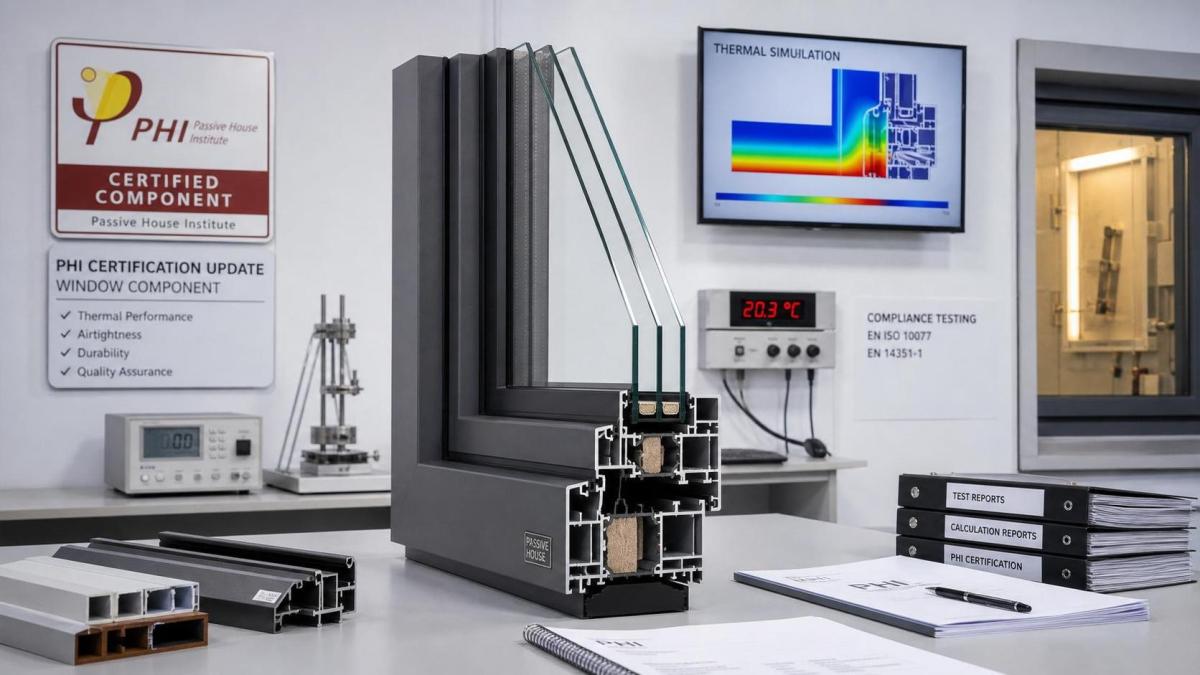
What the new PHI guide now requires
The Passive House Institute (PHI) made the PHI Certified Passive Windows 2026 technical implementation guide effective on June 20, 2026. For all new applications, the guide requires submission of a dynamic thermal simulation report for the full window system based on EN ISO 10077-2:2023. The required reporting scope includes condensation risk, thermal bridge coefficient Ψ values, and four-season load curves.
The updated guide also adds third-party batch testing for the anti-creep performance of PA66 thermal breaks. According to the provided event summary, the change is expected to increase document preparation complexity and extend the average certification cycle for Chinese suppliers exporting passive windows to the EU by around two to three weeks.
Where the pressure is likely to appear first
Export certification workflows face a higher document burden
From an industry perspective, exporters and certification-related companies are likely to feel the impact first because the rule change applies directly to new PHI applications. The practical effect is not limited to one extra form; it shifts the application file toward system-level thermal evidence, which means teams must pay closer attention to whether simulation outputs, condensation assessment, Ψ-value documentation, and seasonal load data are prepared in a form acceptable for review.
Manufacturing and technical teams may need tighter file coordination
For processing and manufacturing companies, the update matters because certification evidence now reaches deeper into full-window system performance and material verification. Analysis shows that technical departments, product engineering staff, and document control teams may need closer alignment so that application files, supporting test materials, and model-based thermal documentation are prepared consistently before submission.
Procurement and supply chain control gain more compliance relevance
Procurement teams and supply chain service providers should also pay attention to the added third-party batch anti-creep testing requirement for PA66 thermal breaks. Observably, this creates a stronger link between material batch management and certification readiness, so supplier qualification, batch traceability, and supporting test records become more relevant to export preparation and delivery planning.
Buyers and project delivery teams may need timeline adjustments
For buyers, distributors, and project delivery teams, the most immediate issue may be timing. The provided information indicates that the average certification process for affected Chinese suppliers may be extended by two to three weeks. That makes certification lead time, document completeness, and application sequencing more important in procurement schedules and shipment planning where PHI-certified passive windows are a condition of supply.
What companies should review now
Check whether current application files match the new evidence scope
What deserves closer attention is whether ongoing or planned applications already account for the required full-window dynamic thermal simulation under EN ISO 10077-2:2023. Companies should review whether their existing technical file structure covers condensation risk, Ψ values, and four-season load curves, rather than assuming prior document practice will remain sufficient.
Reassess material documentation around PA66 thermal breaks
Businesses using PA66 thermal breaks should pay attention to how batch-level third-party anti-creep testing is documented and connected to certification submissions. Since the input does not provide detailed implementation procedures, it is more appropriate to treat this as a compliance checkpoint that needs close monitoring rather than as a fully standardized execution path already settled across all cases.
Adjust procurement and delivery planning for a longer approval cycle
Analysis shows that companies serving EU-bound passive window projects may need to build extra time into application, procurement, and delivery coordination. Where certification timing is commercially sensitive, teams should review tender files, customer document lists, and internal submission milestones to reduce the risk of delays caused by incomplete technical evidence.
Watch for execution language and market-side interpretation
Because the provided information confirms the rule change and its immediate compliance direction, but not every downstream implementation detail, companies should continue tracking how certification language, buyer document expectations, and market-facing specification requirements are expressed in practice.
Why this looks like an execution signal, not just a wording update
In editorial observation, this development is more appropriately understood as an execution-level compliance signal rather than a purely symbolic revision. The reason is that the change does not only rename a requirement; it adds specific technical evidence categories and a new third-party batch test item that can affect application preparation and certification timing.
At the same time, it would be premature to treat every downstream market effect as settled fact. Observably, the confirmed change is clear at the rule level, while the broader impact on tender practice, customer acceptance timing, and workflow standardization still requires continued observation through implementation feedback.
How to read the change at this stage
At this stage, the PHI update is best read as a concrete tightening of certification entry requirements for new passive window applications, with practical consequences for technical files, supplier coordination, and export scheduling. A neutral reading is that the rule has already taken effect, while its full operational impact on project pacing and market practice still depends on how certification reviews and supply-chain responses develop in the coming period.
Basis of this article and what still needs verification
This article is generated from the user-provided news title, event date, and event summary. For developments of this type, commonly relevant source categories may include official notices, regulatory or certification body publications, trade administration information, industry association updates, standard organization documents, and reporting by established industry media.
A specific official source link was not provided in the input, so the underlying official text and subsequent implementation details still require ongoing verification. What remains worth monitoring includes detailed certification interpretation, execution criteria in practice, possible changes in tender documentation, industry feedback, and how companies adjust their application and supply-chain processes.
Recommended News